
Air Conditioning Repair in Grand Junction, CO
AC repair, tune-ups, and diagnostics to keep your system running through Grand Junction summers.
A central air system that's losing cooling power or running constantly without keeping the house comfortable is usually fixable without a full replacement. GPS Plumbing & Mechanical repairs and tunes up residential and light commercial AC systems, and can tell you honestly when a repair makes sense versus when the unit's reached the end of its useful life.
We also handle thermostat installation and full system diagnostics if your AC is behaving inconsistently and you're not sure why.
Serving Grand Junction, Fruita, Palisade, Clifton, Delta, Montrose, and the rest of Mesa County.
What's included
- AC repair & tune-ups
- Refrigerant & coil issues
- Thermostat installation
- No-cool calls
- Filter & maintenance service
- System diagnostics
Signs you need this
- The AC is running but not actually cooling the house
- Weak airflow from the vents
- Ice forming on the outdoor unit or refrigerant lines
- Higher humidity indoors than usual
- Short cycling: turning on and off frequently
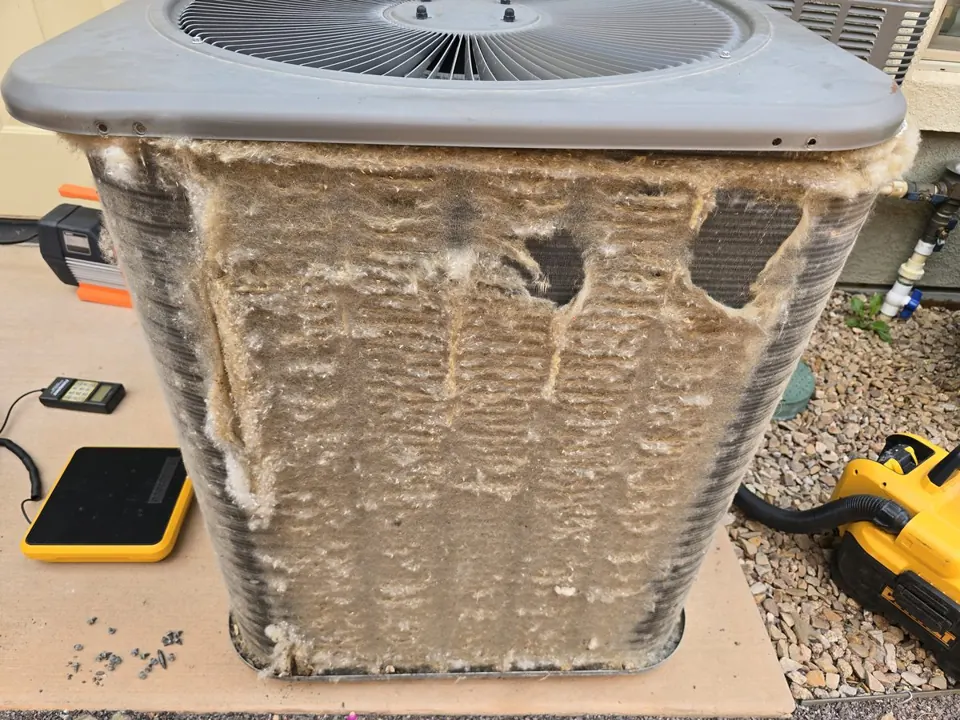
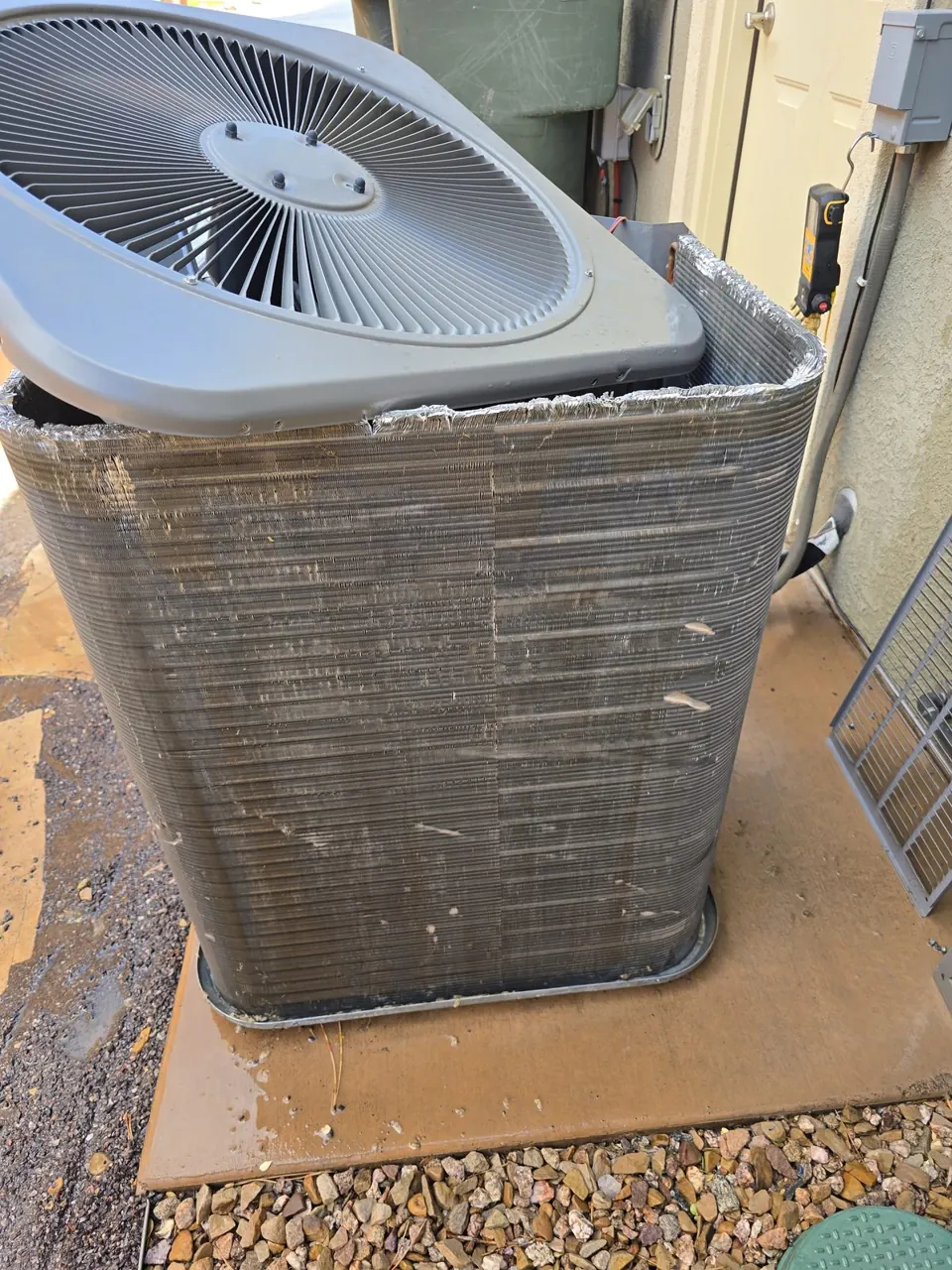
Coil cleaning makes a difference
Cottonwood fluff, dust and debris can pack the outdoor coil and choke off airflow, forcing the system to work harder and cool less. Cleaning the coil is a regular part of an AC tune-up.
How central air conditioning cools your home
An air conditioner does not make cold air. It moves heat. Refrigerant circulates between an indoor coil and an outdoor unit. Inside, the cold coil absorbs heat from your house air as the blower pushes air across it. The refrigerant carries that heat outside, where the condenser coil and fan release it. A compressor keeps the refrigerant moving and under pressure.
That is why airflow is everything. The system needs warm air moving across the indoor coil and outdoor air moving across the condenser coil. If either is restricted by a dirty filter, a clogged coil or a failing fan, cooling drops, and the compressor works harder and wears out sooner.
Grand Junction is hard on air conditioners
The valley averages about 68 days a year at 90°F or hotter, in a dry climate, so central AC runs a lot. A few local conditions make that harder on the equipment.
- Cottonwood fluff. In early summer the cottonwoods release seeds that blow around the valley and pack into the outdoor coil. The photos above show what a coil looks like when it is clogged. A packed coil cannot shed heat, and the system runs longer, cools less and can overheat.
- Dust and wind. Dry air and spring winds put dust on the coil and into the filter faster than in many regions.
- Long runtime. Warm nights mean the system does not get much rest from June through August.
- Attic and roof heat. Ducts and units in hot attics lose capacity and work harder.
The practical answer is a spring tune-up. Cleaning the coil and checking the electrical parts before the first 90°F week is the cheapest way to avoid a failure in July.
Common AC problems and their causes
- Running but not cooling. Dirty condenser coil, clogged filter, failed capacitor or fan motor, a dirty indoor coil, or low refrigerant.
- The outdoor fan or compressor will not start. Often a failed capacitor or contactor. These are common, relatively small parts, but they should be replaced with the power off.
- Ice on the coil or refrigerant lines. Restricted airflow, low refrigerant or a failing blower. Turn the system off and let it thaw before running it again.
- Water around the indoor unit. A clogged condensate drain line, or a frozen coil melting.
- Short cycling. The system turns on and off in short bursts. Causes include an oversized system, a dirty coil, a thermostat problem or a refrigerant issue.
- Weak airflow from the vents. A clogged filter, a failing blower, collapsed or leaking ducts, or closed registers.
- Strange noises. Rattling, buzzing, squealing or grinding usually point to a loose panel, a failing motor bearing or a compressor problem. Shut it off and call.
- The system will not turn on. Thermostat, tripped breaker, a blown fuse or a tripped float switch on the drain.
What you can check before you call
A few quick checks cost nothing and can save a service call or help us diagnose faster.
- Make sure the thermostat is set to cool, set below the room temperature, and has fresh batteries if it uses them.
- Check the breaker and the disconnect near the outdoor unit.
- Check the air filter. If it is gray and clogged, replace it.
- Walk around the outdoor unit and clear leaves, weeds and cottonwood fluff from around it, leaving a couple feet of clearance.
- If the coil looks packed with debris, turn the power off at the disconnect first. You can gently rinse the coil from the inside out with a garden hose. Do not use a pressure washer, which bends the thin fins.
- Look for ice on the indoor coil or the refrigerant lines. If you see any, turn the system off.
Do not open electrical panels or handle refrigerant. If the quick checks do not fix it, call us and tell us what you saw.
Thermostats, ductwork and airflow
Many comfort complaints that look like an AC problem are really airflow problems. Leaky or poorly insulated ducts in an attic or crawlspace can lose a big share of the cooling before it reaches the room. Closed or blocked registers, a dirty blower wheel or an undersized return can starve the system of air even when the equipment is fine.
The thermostat matters too. A thermostat in direct sun or near a heat source will misread the house. Setting the fan to "on" instead of "auto" runs the blower constantly and can put moisture from the coil back into the house. If some rooms are always warmer than others, a duct and airflow check is a smart place to start before replacing equipment.
What an AC tune-up covers
- Clean the outdoor condenser coil
- Check the indoor coil, drain line and filter
- Inspect and test the capacitor, contactor and electrical connections
- Check the blower and condenser fan motors
- Check refrigerant lines and look for signs of leaks
- Check refrigerant pressures and temperature drop where the system allows
- Test the thermostat and the cooling cycle
The best time is spring, before the heat arrives. A tune-up does not guarantee nothing will fail, but it finds worn parts while they can be scheduled, and it keeps the system running at the efficiency it was built for.
Refrigerant: what to know
Refrigerant is not used up like fuel. In a sealed system the amount stays the same unless there is a leak. If a system is low, the right fix is to find and repair the leak, not simply keep adding refrigerant. Topping off a leaking system is temporary and can get expensive.
Refrigerant types also change over time. Older systems built before about 2010 often use R-22, which has not been produced in the United States since 2020, and the remaining supply is expensive. Most newer systems use R-410A, and newer designs are moving to other refrigerants under federal phase-down rules. If your older system has a major leak, a repair is sometimes not worth the cost, and we will say so plainly.
Repair, replace and sizing
Central air conditioners often last 12 to 15 years. A repair makes sense on a younger system with a failed part like a capacitor, contactor or fan motor. Replacement deserves a look when the system is near the end of its life, has a failed compressor or a leaking coil, uses a phased-out refrigerant, or needs frequent repairs.
When replacing, size matters. Sizing should come from the actual heat load of the home: insulation, windows, sun exposure, ducts and square footage. An oversized unit cools quickly, shuts off and never removes enough moisture or runs long enough to even out temperatures. An undersized one runs constantly and can not keep up on a 100°F day. Ductwork matters too, since leaky ducts waste cooling before it gets to the room.
If you are comparing central air to the swamp cooler many valley homes use, our evaporative cooler page explains how they differ. Coolers work well in dry air and use less electricity, but they struggle when humidity rises, and they do not cool as deeply as refrigerated air. We service both. Estimates are free and in writing, and financing is available on larger jobs.
What affects the price
Prices depend on the details, so we don't quote blind. Every job gets a free written estimate before any work starts, so you know the cost up front. Diagnostics are free in the Grand Valley. Outside the Grand Valley, a $79.99 service call fee covers locations up to 50 miles from Grand Junction, plus $2 per one-way mile beyond that. The $79.99 is credited toward the work if you go ahead with the repair; the additional mileage is not credited. Here's what usually drives the cost:
- The problem found: a dirty coil or failed capacitor versus a compressor or refrigerant leak
- Age and type of system
- Whether a repair is worth it, or the system is near the end of its life
- Parts availability
How it works
Call or request service
Tell us what is going on and we will get you on the schedule.
We diagnose & quote
We diagnose the problem on site and give you a free written estimate.
We do the work
We complete the job, walk you through what we did, and warranty our labor for one year.
Air Conditioning Repair questions
How often should I have my AC tuned up?
Once a year, ideally in spring before the hot weather arrives. A tune-up includes cleaning the coil and checking the electrical components and airflow, and it helps catch small problems early.
Why is my AC running but not cooling?
Common causes include a dirty condenser coil, a clogged filter, a failed capacitor or fan motor, or low refrigerant from a leak. We'll diagnose it and give you a written estimate.
Why is there ice on my AC unit?
Ice usually means restricted airflow, often from a clogged filter or dirty coil, or low refrigerant. Turn the system off so the ice can melt and call us. Running it while frozen can damage the compressor.
How long does a central AC last?
Often 12 to 15 years, depending on the unit and how well it's maintained. If yours is older and repairs are mounting up, we'll walk through repair versus replacement.
Is the work warranted?
Our labor is warranted for one year. Parts and equipment are covered by the manufacturer's warranty. We do not cover or offer a warranty on customer-supplied material or equipment.
Free estimate. Financing available.
Free written estimates, straight answers, and a licensed contractor who shows up when promised. For bigger jobs, check your financing rate in a couple of minutes with no impact to your credit score.