
Boiler Repair in Grand Junction, CO
Hydronic heat troubleshooting, repair, and maintenance to keep your system running through the Western Slope winter.
Boiler systems are reliable, but they're also more specialized than standard forced-air furnaces, and not every HVAC company works on hydronic heat. GPS Plumbing & Mechanical troubleshoots and repairs circulator pumps, zone valves, expansion tanks, and the rest of the hydronic system, and handles routine maintenance to keep a boiler running efficiently for years.
If you're dealing with a no-heat call, uneven heat between rooms, or a boiler that's making noise it shouldn't, we can usually diagnose the issue on-site and give you a written estimate before any work starts.
Serving Grand Junction, Fruita, Palisade, Clifton, Delta, Montrose, and the rest of Mesa County.
What's included
- Boiler troubleshooting
- Boiler repair
- Circulator pumps
- Zone valves
- Expansion tanks
- Hydronic heating
- Boiler maintenance
- No-heat calls
Signs you need this
- No heat, or heat that's noticeably weaker than usual
- Some rooms or zones heating while others stay cold
- Banging, gurgling, or knocking sounds from the boiler or pipes
- Water pooling around the base of the unit
- A pilot light that won't stay lit, or an error code on the display
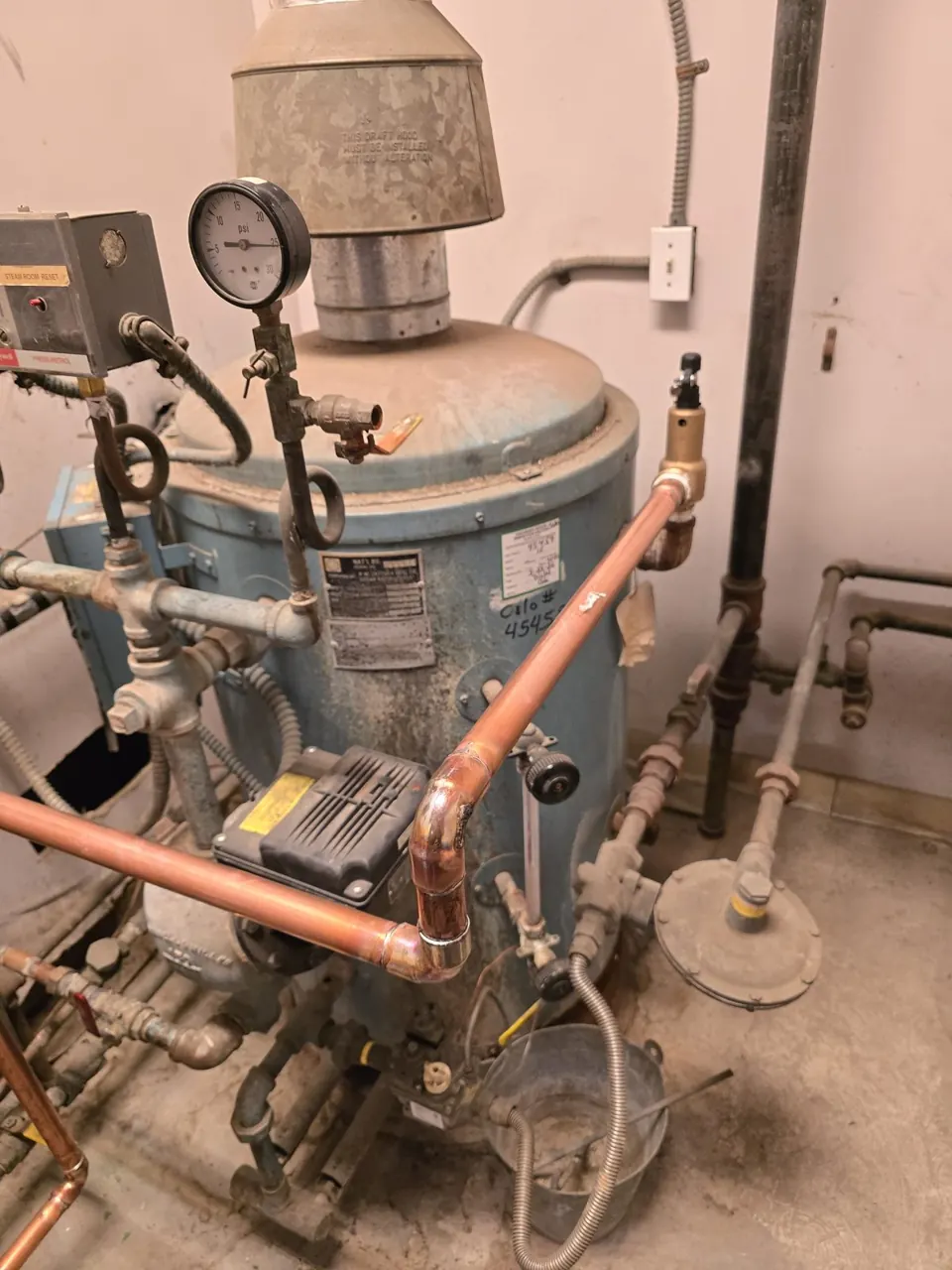
A recent boiler repipe
Replacing worn piping, valves and fittings around a boiler can restore reliable heat and head off leaks. We repipe and service hydronic systems with the same care as the boiler itself.
How a hydronic heating system works
A boiler heats water, a circulator pump moves it through pipes to radiators, baseboard or in-floor tubing, and the cooled water returns to be heated again. Because the heat is carried by water instead of air, it is quiet and even, and there are no ducts to circulate dust. That is why many Grand Junction homes, especially older ones and some commercial buildings, still use hydronic heat.
The system is closed, which means the same water circulates. It is held at a certain pressure, typically around 12 to 15 psi when cold in a home, depending on the building. When the pressure or the water level is wrong, or air gets into the loop, problems follow.
Most residential boilers are one of two types. Cast iron boilers are heavy and durable, and many last decades. High-efficiency condensing boilers use a second heat exchanger to pull extra heat from the exhaust, vent through plastic pipe, and need a condensate drain. They are efficient but have more electronic controls.
Radiators, baseboard and in-floor heat
The way a boiler delivers heat affects how it behaves and what goes wrong.
- Cast iron radiators hold a lot of water and release heat slowly and evenly. Air that builds up in them is usually released with a small bleed valve.
- Fin-tube baseboard is common in homes. It heats quickly but depends on clean fins and clear airflow. Furniture pushed against it or dust packed into the fins cuts heat output.
- In-floor radiant tubing runs at lower water temperatures and often has a mixing valve or injection pump. It gives very even heat, but tubing problems are hard to reach, which is why correct pressure and clean water matter.
- Combination systems may feed an indirect water heater, so one boiler heats both the house and the hot water.
If you are not sure what type of system you have, describe what you see at the room level (radiators, baseboard, floor) and what is in the mechanical room, and we can start from there.
The parts that fail most often
- Circulator pump. It moves the water. A failing pump can hum, get hot, leak at the flange or stop. If the boiler is firing but the house is cold, the pump is a prime suspect.
- Zone valves. Many homes have separate zones with their own valves. A stuck valve or a failed motor can leave one zone cold while the others heat.
- Expansion tank. It absorbs the pressure from heated water expanding. When its air side fails or the bladder ruptures, pressure swings and the relief valve may drip.
- Air vents and air separators. They remove trapped air. A stuck vent or an air-bound loop causes gurgling and cold spots.
- Pressure relief valve. A safety device that opens at a set pressure. If it leaks, the cause may be a bad expansion tank or an over-pressurized system, not just a bad valve.
- Fill valve or pressure regulator. It adds water when pressure drops. A failed one can over-pressurize the system or hide a leak by constantly refilling.
- Low-water cutoff and limit controls. Safety controls that shut the boiler down if water is low or temperatures are too high.
- Ignition, flame sensor and gas valve. The same type of parts that fail on a furnace.
What the symptoms usually mean
- Pressure keeps dropping. The system is losing water somewhere. It may be a leak in a pipe, a fitting or the boiler, or a failed expansion tank or relief valve. Constantly topping off the pressure can hide a leak and feed corrosion.
- Pressure goes too high. Often a failed expansion tank or a fill valve that is passing water.
- Knocking or banging. Air in the lines, a failing pump, or mineral scale on the heat exchanger. A boiler that makes a rumbling or kettle-like sound may have scale buildup.
- Gurgling or rushing water. Air in the system. Bleeding the radiators or baseboards and fixing the source of air usually helps.
- Some rooms are cold. A closed or stuck zone valve, trapped air, or a blocked baseboard element.
- The boiler turns on and off quickly. Short cycling can come from a boiler oversized for the load, bad controls, a dirty heat exchanger or a pump problem.
- Water under or around the boiler. A leaking valve, fitting, pump flange or the boiler itself. If it is the boiler heat exchanger, replacement may be needed.
- No heat and no hot water. If your boiler also supplies domestic hot water, a failure takes both out.
What an annual boiler service covers
A boiler is a closed loop that does not need much, but what it needs, it needs every year. Our pre-winter boiler checklist walks through what to look for yourself. A professional visit adds the parts that need tools and training.
- Check system pressure, the expansion tank and the fill valve
- Look for leaks at the boiler, pump, valves and piping
- Test the pressure relief valve and safety controls
- Inspect the burner, ignition and flame sensor, and clean as needed
- Inspect the venting and the condensate drain on condensing boilers
- Check the circulator and zone valve operation
- Bleed air from the system where needed
- Check thermostats and zone controls
Doing this in early fall gives you time to repair what we find before heating season, without a no-heat emergency.
Repair or replace a boiler
Boilers often last longer than furnaces. A well-maintained cast iron boiler can run for decades, and a condensing boiler typically lasts 15 to 20 years. That makes the repair decision different.
- Repair first for a failed pump, zone valve, expansion tank, air vent or control. Those are normal wear items, and replacing them often restores years of service.
- Consider replacement when the heat exchanger is cracked or leaking, the boiler is badly corroded, parts are no longer available, or the unit is so old that repairs are frequent and it uses a lot of fuel.
Parts availability on older boilers matters. We will tell you honestly if a repair is a good value or if the money is better spent toward a new unit, and you will get both options in writing. Financing is available for replacement.
Boiler safety and winter protection
Like a furnace, a gas boiler can produce carbon monoxide if it is not venting properly, so keep working CO alarms in the home. Never plug, cap or tamper with the relief valve or its discharge pipe. If you smell gas, follow the safety note at the top of this page.
In winter, a boiler in an unheated garage, outbuilding or crawlspace can freeze, and a frozen loop can split pipes. Keep the heat on if you travel, and ask us about freeze protection for those spaces. Some systems use antifreeze (glycol) in the loop, which is a different maintenance routine than plain water, so make sure you know what is in yours. Our guide to preventing frozen pipes and our heat tape page cover the supply lines and nearby plumbing.
If you have a power outage, a boiler will not run because the controls and the pump need electricity. If you have a long outage in a cold snap, keep the house from freezing and call us when power returns if anything seems off.
What affects the price
Prices depend on the details, so we don't quote blind. Every job gets a free written estimate before any work starts, so you know the cost up front. Diagnostics are free in the Grand Valley. Outside the Grand Valley, a $79.99 service call fee covers locations up to 50 miles from Grand Junction, plus $2 per one-way mile beyond that. The $79.99 is credited toward the work if you go ahead with the repair; the additional mileage is not credited. Here's what usually drives the cost:
- Which component failed: a circulator or zone valve versus a larger part
- Boiler type and age, which affect parts availability
- Whether the system needs bleeding, repiping or an expansion tank replacement
- Whether repair or replacement is the better value
How it works
Call or request service
Tell us what is going on and we will get you on the schedule.
We diagnose & quote
We diagnose the problem on site and give you a free written estimate.
We do the work
We complete the job, walk you through what we did, and warranty our labor for one year.
Boiler Repair questions
How often should a boiler be serviced?
Once a year, before heating season. A fall check catches problems like failing pumps, leaking valves, and low pressure while it's still easy to schedule. Our pre-winter boiler checklist covers what to look at.
Why are some rooms or zones cold?
That can be a stuck zone valve, a failing circulator pump, or air trapped in the lines. A technician can find which it is.
Why is my boiler making banging or gurgling noises?
Air in the system, low water or pressure, or mineral buildup are common causes. It's worth having it looked at so a small issue doesn't become a no-heat call.
My boiler pressure keeps dropping. What does that mean?
Falling pressure can mean a leak somewhere in the system, or a problem with the expansion tank or relief valve. Don't keep topping it off without finding out why.
Is the work warranted?
Our labor is warranted for one year. Parts and equipment are covered by the manufacturer's warranty. We do not cover or offer a warranty on customer-supplied material or equipment.
Free estimate. Financing available.
Free written estimates, straight answers, and a licensed contractor who shows up when promised. For bigger jobs, check your financing rate in a couple of minutes with no impact to your credit score.