
Water Heater Repair & Replacement in Grand Junction
Gas, electric, and tankless water heaters repaired, replaced, and maintained for homes and businesses across Grand Junction, Fruita, Palisade, Clifton, and Mesa County.
No hot water is a problem you feel right away. GPS Plumbing & Mechanical repairs and replaces gas, electric, and tankless water heaters for homes and businesses in Grand Junction, Fruita, Palisade, Clifton, and across Mesa County, and we'll tell you honestly whether a repair still makes sense or it's time for a new unit.
If you do need a replacement, we size the unit to your household or building instead of putting in whatever happens to be on the truck. A unit that's too small runs out of hot water. One that's too large wastes energy and can shorten the life of the equipment.
Serving Grand Junction, Fruita, Palisade, Clifton, Delta, Montrose, and the rest of Mesa County.
What's included
- Gas, electric, and tankless water heater installation
- Water heater repair, including pilot light, thermostat, and heating element problems
- Full replacement
- Sediment flushing and maintenance
- Replacement for both homes and commercial buildings
Signs you need this
- No hot water, or hot water that runs out quickly
- Lukewarm water no matter how long you wait
- Rusty or discolored water from the hot tap
- Popping, rumbling, or banging sounds from the tank
- A tank more than 10 years old, or any water pooling around the base
Repair or replace?
As a rough guide, a simple repair (a thermostat, a heating element, a pilot or ignition problem) usually makes sense on a newer unit that isn't leaking. Replacement is usually the better value when the tank itself is leaking, the unit is well past 10 years old, or you've already paid for repeated repairs. We'll walk through both options and give you the numbers in a written estimate before any work begins. For a longer walkthrough, read our repair-or-replace guide, or see our tankless water heater page.
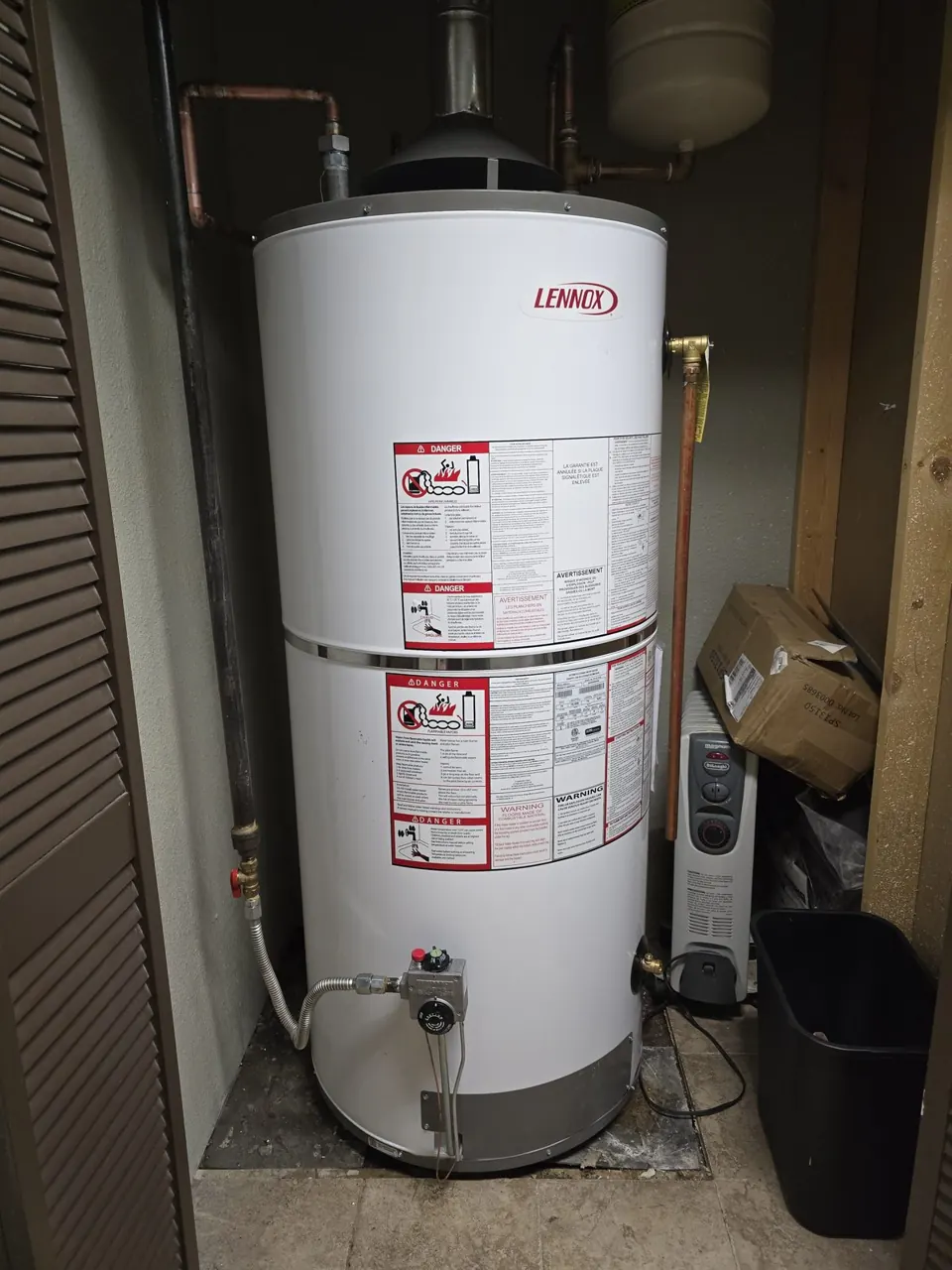
A recent replacement
A properly sized, properly vented water heater with the right shut-offs and a clean gas connection is what a good install looks like. We take the same care on every unit, from a basic 40-gallon tank to a commercial system.
How a tank water heater works
A tank water heater is an insulated steel tank, usually 30 to 75 gallons in a home, that keeps water hot and ready. Cold water enters at the bottom through a dip tube, gets heated, and the hot water leaves from the top. That is why a unit can run out of hot water: once the tank is used up, the new cold water has to be heated before it is ready.
The difference between gas and electric is how the heat is made.
- Gas water heaters have a burner under the tank. A thermostat and gas control valve light the burner when the water cools, and the exhaust gases leave through a vent pipe. Gas units usually recover faster, so they tend to keep up better in busy households.
- Electric water heaters have two heating elements inside the tank, an upper and a lower, controlled by thermostats. There is no flame and no vent, but they typically recover more slowly and need a dedicated circuit that can handle the load.
Both types have the same safety parts that matter most: a temperature and pressure relief valve that opens if the tank gets too hot or the pressure climbs too high, and shut-off valves so the unit can be isolated for service.
Common water heater problems and what causes them
Most water heater trouble falls into a handful of patterns. Knowing which one you have makes the conversation with a technician faster, and it helps you judge whether a repair makes sense.
- No hot water at all. On a gas unit, this is often a pilot or ignition problem, a failed thermocouple or flame sensor, or the gas supply being interrupted. On an electric unit, it is usually a tripped breaker, a tripped high-temperature limit switch or a failed heating element.
- Not enough hot water. A failed lower element on an electric unit, a broken dip tube, a thermostat set too low or heavy sediment in the tank can all shorten your hot water. It can also simply mean the tank is too small for the household now.
- Water that is lukewarm. A bad thermostat, a failed element or a mixing problem in a single-lever shower valve can cause it, so the heater is not always the culprit.
- Rumbling, popping or banging. Minerals settle on the tank bottom as sediment. When the burner or element heats the water under that layer, steam bubbles push up through it and make noise. Flushing can help on a younger tank.
- Rusty or brown hot water. If only the hot side is rusty, the inside of the tank or the anode rod is usually failing. If both hot and cold are rusty, the problem is more likely in the piping.
- Water around the base. A leak from a fitting, a drain valve or the relief valve line can sometimes be fixed. Water coming out of the tank itself cannot, and the unit needs to be replaced. Shut off the water to the heater and call us.
- A smell like rotten eggs. That is usually bacteria reacting with the anode rod in the tank. It is a water quality issue, not a gas leak, but if you are ever unsure, treat it as gas and follow the safety note at the top of this page.
Maintenance that actually extends the life of a water heater
A water heater is one of the most neglected appliances in a house because it works quietly for years. A little attention goes a long way, especially where water is hard.
- Flush the tank. Draining a few gallons from the drain valve, or fully flushing the tank, removes sediment before it hardens. Sediment makes the unit less efficient, noisier and harder on the tank bottom. An older tank that has never been flushed can be touchy, so it is worth having a professional look at it first.
- Check the anode rod. The anode rod is a metal rod inside the tank that corrodes so the tank does not. Once it is used up, the tank itself starts to rust. Inspecting and replacing it can add years to a tank, but it needs to be done before the tank is badly corroded.
- Test the relief valve. The relief valve should lift and reseat. If it does not move, or drips constantly afterward, it should be replaced. Never cap or plug the discharge pipe.
- Set a safe temperature. Most manufacturers and safety agencies suggest around 120°F for household use. Hotter water raises the scalding risk, especially for children and older adults, and wastes energy.
- Keep the area clear. Do not store paint, gasoline, cleaners or boxes against a gas water heater. Vapors and clutter near an open flame are a fire risk, and the unit needs air to burn properly.
If you would like us to look it over, a maintenance visit is a good time to check the venting, the gas connection, the relief valve and the anode condition together.
Sizing a replacement water heater
Bigger is not always better. A tank that is too small runs out of hot water, and one that is too large costs more to buy and keeps more water hot than you need. The right size depends on how many people live in the house, how many bathrooms you have and how much hot water you use at the same time.
Two numbers matter on the label. The tank capacity in gallons is the storage. The first hour rating is how much hot water the unit can deliver in the first hour of heavy use, which is a better match to a busy morning than the tank size alone. A household with a big soaking tub, a body-spray shower or a teenager who showers for 30 minutes needs more than the headcount suggests.
If a tank is simply too small, or you want to free up floor space, a tankless water heater is the other option. We will go over both with you and put the numbers in your written estimate.
What a proper replacement includes
Swapping a water heater looks simple, but several details separate a good install from a quick one. When a unit is replaced, the whole setup should be looked at, not just the tank.
- Venting. A gas unit must vent combustion gases outside, with the right pipe size, slope and clearances. A bad vent can spill carbon monoxide into the house.
- Gas connection. A gas shut-off, a flexible connector in good condition and a leak check on the connection. If the gas line is undersized or in poor shape, see our gas piping and gas line page.
- Relief valve and discharge pipe. The relief valve needs a proper discharge line that points to a safe place.
- Expansion tank. Many homes have a check valve or pressure regulator on the water service, which makes the plumbing a closed system. When water heats it expands, and without an expansion tank that pressure has nowhere to go and can stress the tank and fixtures.
- Shut-off valves and unions. Good isolation valves make the next repair or flush easy.
- A drain pan where a leak could do damage. A pan with a drain line, for a unit above living space or on a finished floor, limits damage if the tank fails.
We explain what we found and what each item is for, and everything goes in your free written estimate before work starts.
Water heaters in the Grand Valley: altitude, hard water and cold weather
A few local conditions affect water heaters here more than they would at sea level or in a milder climate.
Altitude. Grand Junction sits at about 4,646 feet. Gas appliances burn less efficiently as the air thins, and manufacturers generally specify an input adjustment above 2,000 feet. A unit that is not set up for the altitude can burn poorly, soot up or trip safeties, so the model and its settings matter. That is one more reason a gas water heater is not always a simple swap.
Hard water. Water in much of Colorado is on the harder side. Hard water leaves scale on heating elements, in the bottom of tanks and inside tankless heat exchangers. If you see white crust on faucets and showerheads, your water heater is dealing with the same thing. A water softener protects the heater and everything else downstream.
Cold weather. Winter nights in the valley average well below freezing. Water heaters in garages, crawlspaces and outbuildings need their pipes insulated, and exposed lines may need heat tape. Our guide to preventing frozen pipes covers what to check before the first hard freeze.
Not sure whether to repair or replace what you have? Read our repair-or-replace guide, or call and describe the symptoms.
What affects the price
Prices depend on the details, so we don't quote blind. Every job gets a free written estimate before any work starts, so you know the cost up front. Diagnostics are free in the Grand Valley. Outside the Grand Valley, a $79.99 service call fee covers locations up to 50 miles from Grand Junction, plus $2 per one-way mile beyond that. The $79.99 is credited toward the work if you go ahead with the repair; the additional mileage is not credited. Here's what usually drives the cost:
- Tank or tankless, and the capacity you need
- Gas or electric, and whether the existing gas line, venting or wiring needs changes
- Where the unit is located and how hard it is to remove and install
- Whether the job is a repair or a full replacement
- Code-required parts such as expansion tanks, shut-offs and venting
How it works
Call or request service
Tell us what is going on and we will get you on the schedule.
We diagnose & quote
We diagnose the problem on site and give you a free written estimate.
We do the work
We complete the job, walk you through what we did, and warranty our labor for one year.
Water Heater Repair & Replacement questions
How long does a water heater last?
Standard tank water heaters commonly last around 8 to 12 years, and tankless units often last longer with regular maintenance. Age, water conditions, and maintenance all play a part.
Do you install tankless water heaters?
Yes. We install and service tank and tankless units, both gas and electric. We'll help you decide which fits your home and usage.
Can I finance a water heater replacement?
Yes. Financing is available through Wisetack, and you can check your rate in a couple of minutes with no impact to your credit score.
Do you charge for estimates?
No. Estimates are free and in writing before any work starts.
What areas do you serve?
Grand Junction, Fruita, Palisade, Clifton, the rest of Mesa County, and Delta and Montrose. If you're not sure you're in range, call the office and ask.
Why is my water heater making popping or rumbling noises?
That sound is usually sediment built up at the bottom of the tank, which water has to bubble through. Flushing the tank can help on a younger unit. On an older tank it can be a sign the unit is wearing out.
Is the work warranted?
Our labor is warranted for one year. Parts and equipment are covered by the manufacturer's warranty. We do not cover or offer a warranty on customer-supplied material or equipment.
Free estimate. Financing available.
Free written estimates, straight answers, and a licensed contractor who shows up when promised. For bigger jobs, check your financing rate in a couple of minutes with no impact to your credit score.